Salesforce Sandbox Seeding

/
Context
/
Context
From recovering data to preparing data for real work
From recovering data to preparing data for real work
As Rubrik expanded Salesforce protection, we uncovered a missing step in the user journey: preparing realistic sandbox data.Teams could recover production data—but struggled to set up sandboxes that were actually usable for testing.
As Rubrik expanded Salesforce protection, we uncovered a missing step in the user journey: preparing realistic sandbox data.Teams could recover production data—but struggled to set up sandboxes that were actually usable for testing.
/
Project Goal
/
Project Goal
Help teams set up Salesforce sandboxes without guesswork
Help teams set up Salesforce sandboxes without guesswork
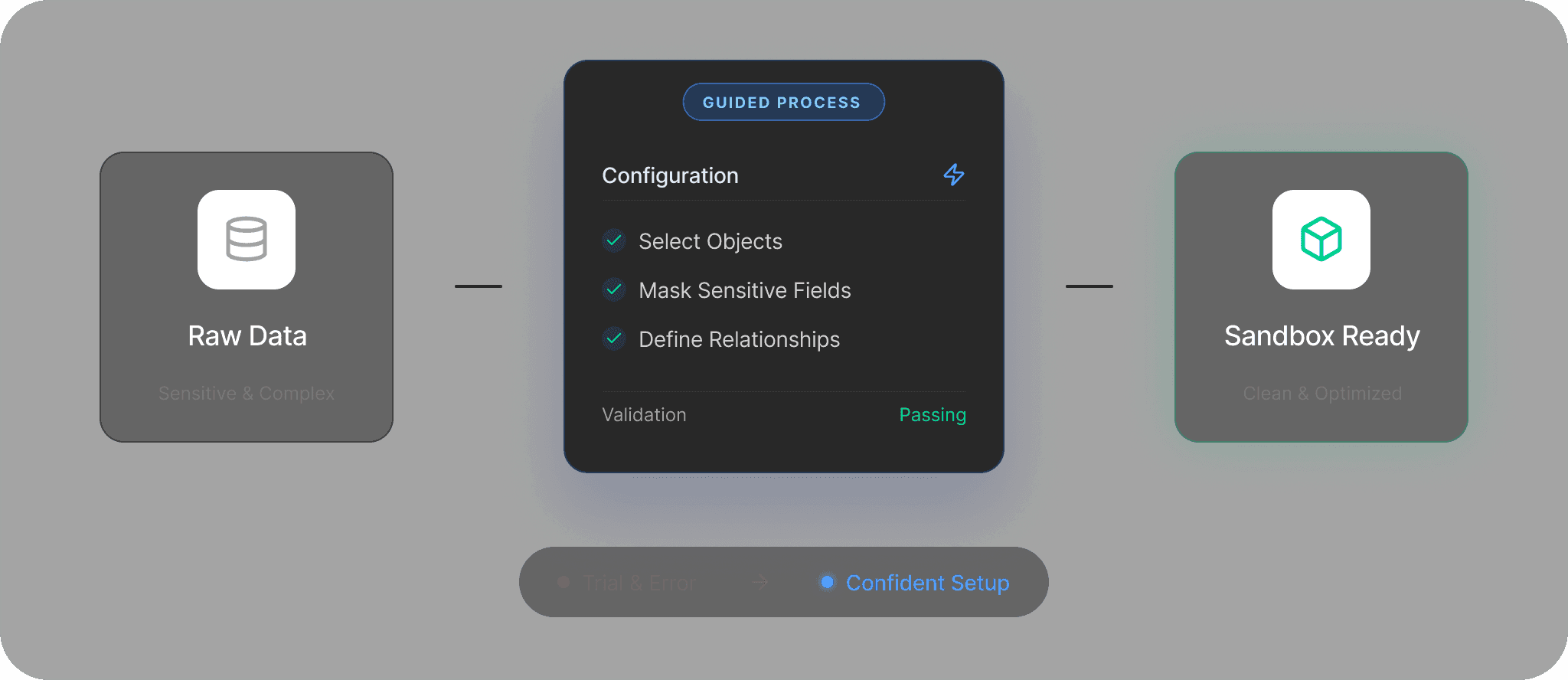
The goal was to guide users through complex data decisions—so they could confidently prepare sandbox data without trial and error.
The goal was to guide users through complex data decisions—so they could confidently prepare sandbox data without trial and error.
/
Solution
/
Solution
Make sandbox setup something teams can reuse with confidence
Make sandbox setup something teams can reuse with confidence
I designed a template-based system that captures data, metadata, and relationship, so teams can reuse proven seeding setups across environments with confidence.
I designed a template-based system that captures data, metadata, and relationship, so teams can reuse proven seeding setups across environments with confidence.
/
Solution
/
Solution
/
Solution
Helping users see the impact of their choices before it’s too late
Helping users see the impact of their choices before it’s too late
I designed a relationship model that reveals how objects connect across parent-child hierarchies and cross-object references. This allowed users to understand the structural impact of selecting or excluding specific objects before seeding data.
I designed a relationship model that reveals how objects connect across parent-child hierarchies and cross-object references. This allowed users to understand the structural impact of selecting or excluding specific objects before seeding data.
/
Solution
/
Solution
/
Solution
I designed a relationship model that reveals how objects connect across parent-child hierarchies and cross-object references. This allowed users to understand the structural impact of selecting or excluding specific objects before seeding data.
I designed a relationship model that reveals how objects connect across parent-child hierarchies and cross-object references. This allowed users to understand the structural impact of selecting or excluding specific objects before seeding data.
/
Solution
/
Solution
/
Solution
Reduce repeated setup work with reusable sandbox presets
Reduce repeated setup work with reusable sandbox presets
I designed presets and automation that encode best practices for common sandbox scenarios.
This enabled users to generate meaningful sandbox datasets with a few clicks, reducing setup time from hours to minutes while maintaining data integrity.
I designed presets and automation that encode best practices for common sandbox scenarios.
This enabled users to generate meaningful sandbox datasets with a few clicks, reducing setup time from hours to minutes while maintaining data integrity.
/
Impact
/
Impact
/
Impact
When better decisions became a platform advantage
When better decisions became a platform advantage
By adding how enterprises make sandbox seeding decisions, we closed a critical capability gap in Rubrik’s Salesforce offering.
Sandbox seeding evolved from a manual workaround into a first-class platform workflow,
enabling faster adoption, stronger differentiation in enterprise deals, and measurable revenue impact.
Accelerated revenue growth x5
Generated $2M ACV in Q3 by enabling sandbox seeding as a deal-critical capability, driving 5× growth in Salesforce pipeline conversions.
Accelerated revenue growth x5
Generated $2M ACV in Q3 by enabling sandbox seeding as a deal-critical capability, driving 5× growth in Salesforce pipeline conversions.
Accelerated revenue growth x5
Generated $2M ACV in Q3 by enabling sandbox seeding as a deal-critical capability, driving 5× growth in Salesforce pipeline conversions.
Closing a critical platform gap
Elevated sandbox seeding from a sales workaround to a first-class product workflow embedded in Rubrik’s SaaS platform.
Closing a critical platform gap
Elevated sandbox seeding from a sales workaround to a first-class product workflow embedded in Rubrik’s SaaS platform.
Closing a critical platform gap
Elevated sandbox seeding from a sales workaround to a first-class product workflow embedded in Rubrik’s SaaS platform.
Winning enterprise adoption
Adopted by 60+ enterprise customers and displaced three competitors in consolidation deals by offering a differentiated sandbox seeding experience.
Winning enterprise adoption
Adopted by 60+ enterprise customers and displaced three competitors in consolidation deals by offering a differentiated sandbox seeding experience.
Winning enterprise adoption
Adopted by 60+ enterprise customers and displaced three competitors in consolidation deals by offering a differentiated sandbox seeding experience.
Project Timeline
4 months (01/2024 - 04/2024)
Team Setup
1 Product Manager, 7 Engineers
My Contribution
Led an end-to-end design process, translating complex user needs into clear system and experience models. Validated key assumptions through rapid prototyping and aligned PM and engineering from concept to launch.
/
My Role
/
My Role
/
My Role
Led the product from ambiguous problem to platform-level outcome
Drove the end-to-end creation of a 0–1 product, from ambiguity to launch
Project Timeline
3 months (Sept - Dec, 2024)
Team Setup
1 Product Manager, 7 Engineers
My Contribution
Led an end-to-end design process, translating complex user needs into clear system and experience models. Validated key assumptions through rapid prototyping and aligned PM and engineering from concept to launch.
/
The Most Memorable Moment
/
The Most Memorable Moment
/
The Most Memorable Moment
When moving early mattered more than being right.
When moving early mattered more than being right.
This project taught me what ambiguity really feels like. At the start, we didn’t even know how to reach our target users. Recruiting took weeks longer than expected, and for a long time, we were designing without direct access to the people we were building for. Waiting felt responsible—but it would have stalled the entire project. I realized that in high-uncertainty environments, progress doesn’t come from certainty. It comes from momentum.
This project taught me what ambiguity really feels like. At the start, we didn’t even know how to reach our target users. Recruiting took weeks longer than expected, and for a long time, we were designing without direct access to the people we were building for. Waiting felt responsible—but it would have stalled the entire project. I realized that in high-uncertainty environments, progress doesn’t come from certainty. It comes from momentum.
Designing Under Ambiguity Meant
Challenging Who We Were Designing For
Designing Under Ambiguity Meant Challenging Who We Were Designing For
Designing Under Ambiguity Meant
Challenging Who We Were Designing For
/
Action before clarity
/
Action before clarity
/
Action before clarity
I moved forward by designing for validation, not assumptions
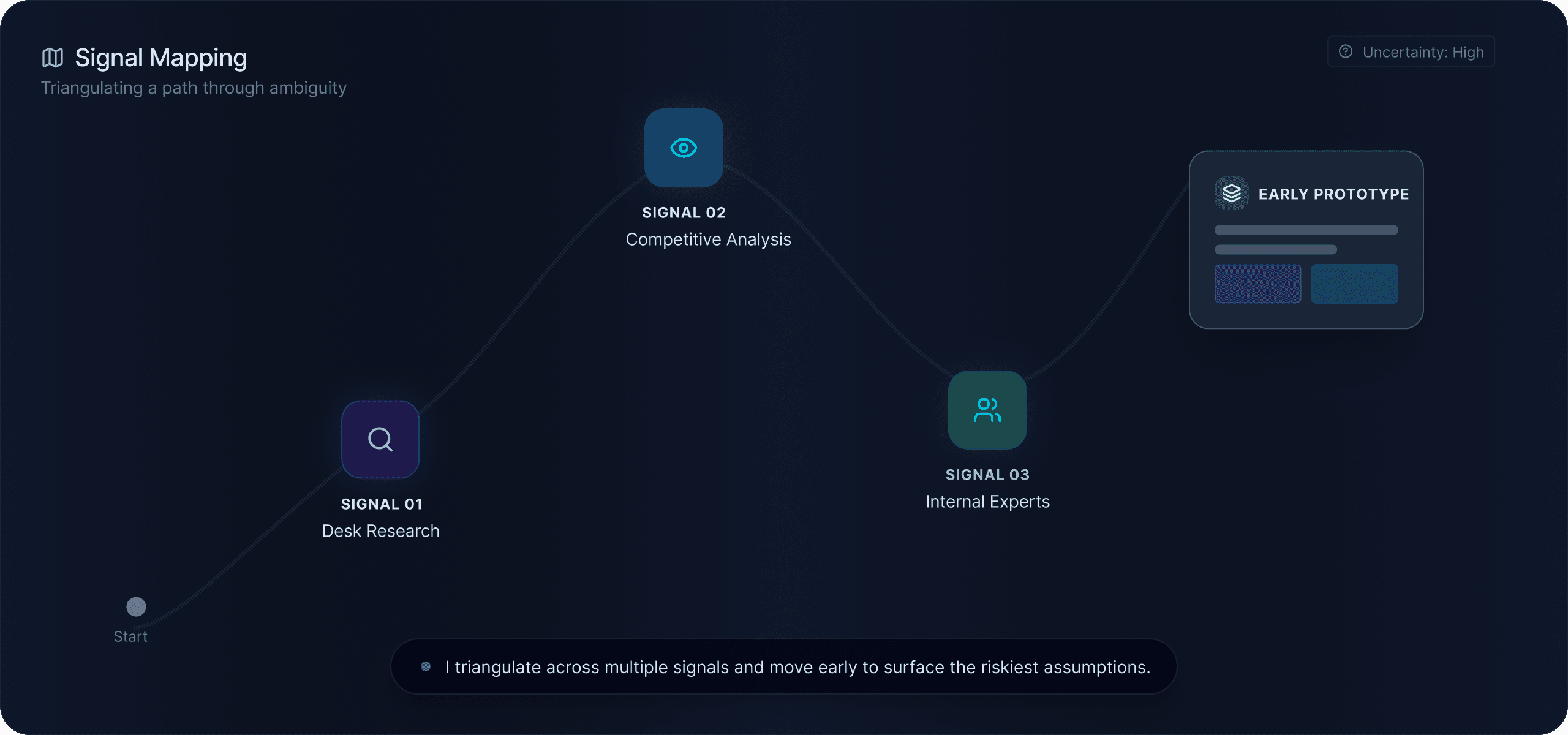
At the start of the Salesforce data protection project, uncertainty was unavoidable. We didn’t yet have access to target users, and no validated mental model to design against.
Instead of waiting for certainty, I focused on creating early artifacts that could be tested and challenged. I synthesized desk research, competitive analysis, and input from internal experts to build initial prototypes—not as final answers, but as hypotheses made concrete.
This allowed the team to move forward with shared reference points, identify fragile assumptions early, and adapt quickly once real user signals became available.
At the start of the Salesforce data protection project, uncertainty was unavoidable. We didn’t yet have access to target users, and no validated mental model to design against.
Instead of waiting for certainty, I focused on creating early artifacts that could be tested and challenged. I synthesized desk research, competitive analysis, and input from internal experts to build initial prototypes—not as final answers, but as hypotheses made concrete.
This allowed the team to move forward with shared reference points, identify fragile assumptions early, and adapt quickly once real user signals became available.
/
Expert bias
/
Expert bias
/
Expert bias
Our first design was optimized for experts, not our target users
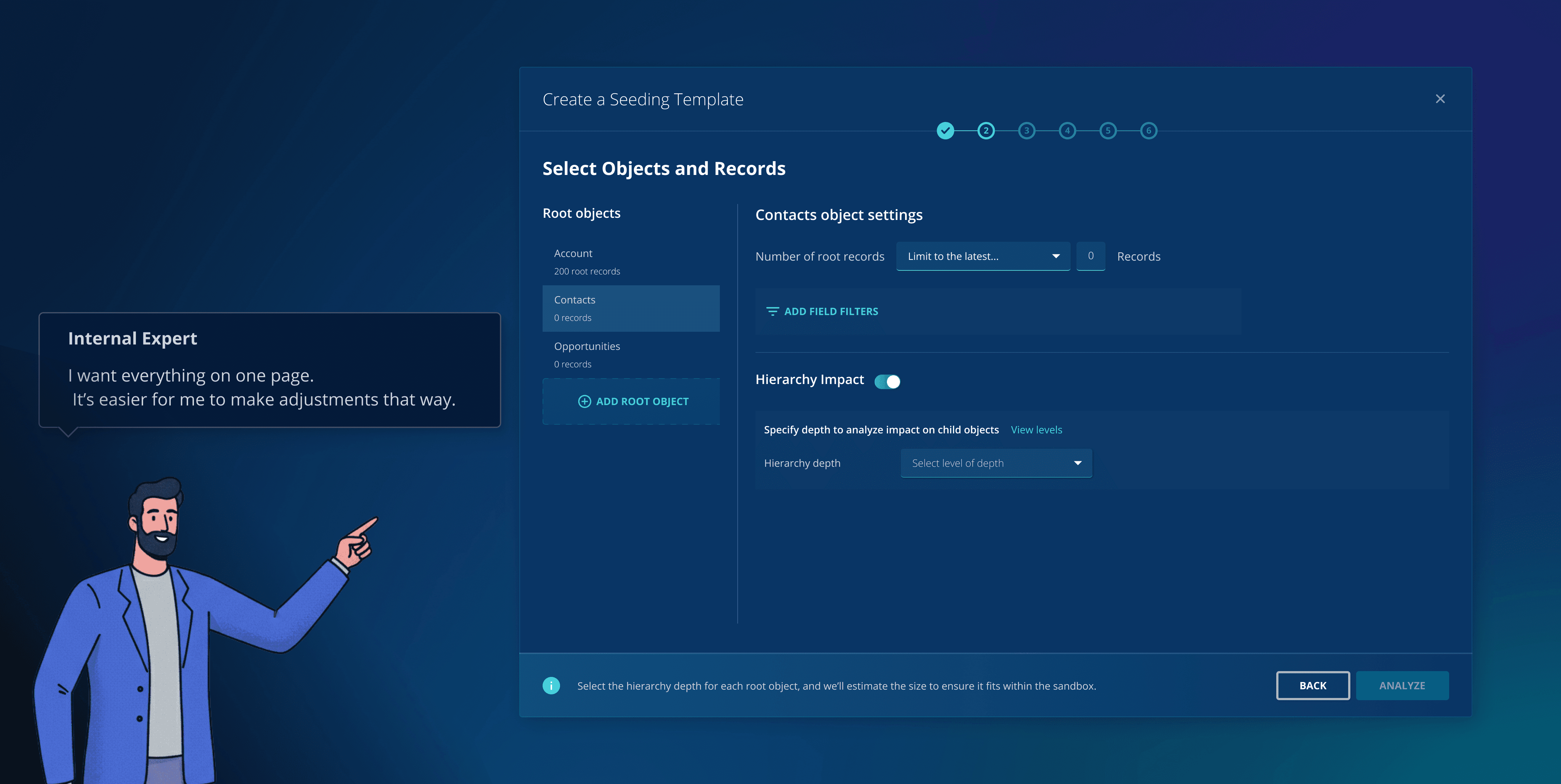
At that stage, we relied heavily on a single internal expert—the head of Salesforce at our company. He was highly experienced and deeply technical.
As expected, the first design closely mirrored his mental model: dense, powerful, and optimized for someone who wanted full control at once. The design itself was coherent and well-structured—but it was anchored in an expert perspective.
What we hadn’t yet validated was whether our target users shared that same mental model.
At that stage, we relied heavily on a single internal expert—the head of Salesforce at our company. He was highly experienced and deeply technical.
As expected, the first design closely mirrored his mental model: dense, powerful, and optimized for someone who wanted full control at once. The design itself was coherent and well-structured—but it was anchored in an expert perspective.
What we hadn’t yet validated was whether our target users shared that same mental model.
/
Assumptions exposed
/
Assumptions exposed
/
Assumptions exposed
Two interviews surfaced a mismatch in mental models
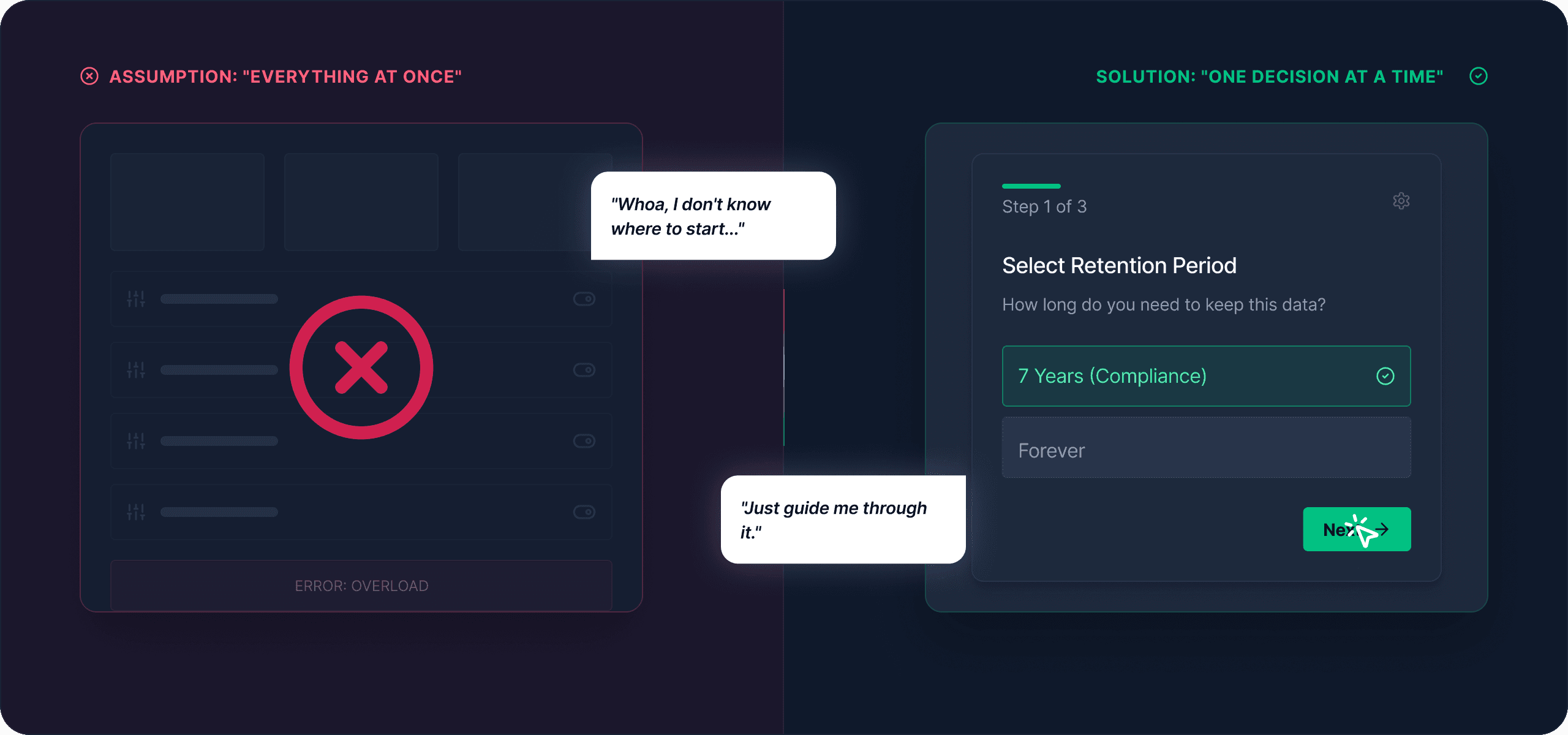
The turning point came when we finally spoke with real target users. After just two interviews, the gap became obvious. These users weren’t super-users. They didn’t want full control upfront. They wanted help deciding, step by step. What they were asking for wasn’t less complexity—it was structured complexity. That moment made the risk clear: the problem wasn’t the system’s sophistication, but how we were asking humans to process it.
The turning point came when we finally spoke with real target users. After just two interviews, the gap became obvious. These users weren’t super-users. They didn’t want full control upfront. They wanted help deciding, step by step. What they were asking for wasn’t less complexity—it was structured complexity. That moment made the risk clear: the problem wasn’t the system’s sophistication, but how we were asking humans to process it.
/
Designing for cognition
/
Designing for cognition
/
Designing for cognition
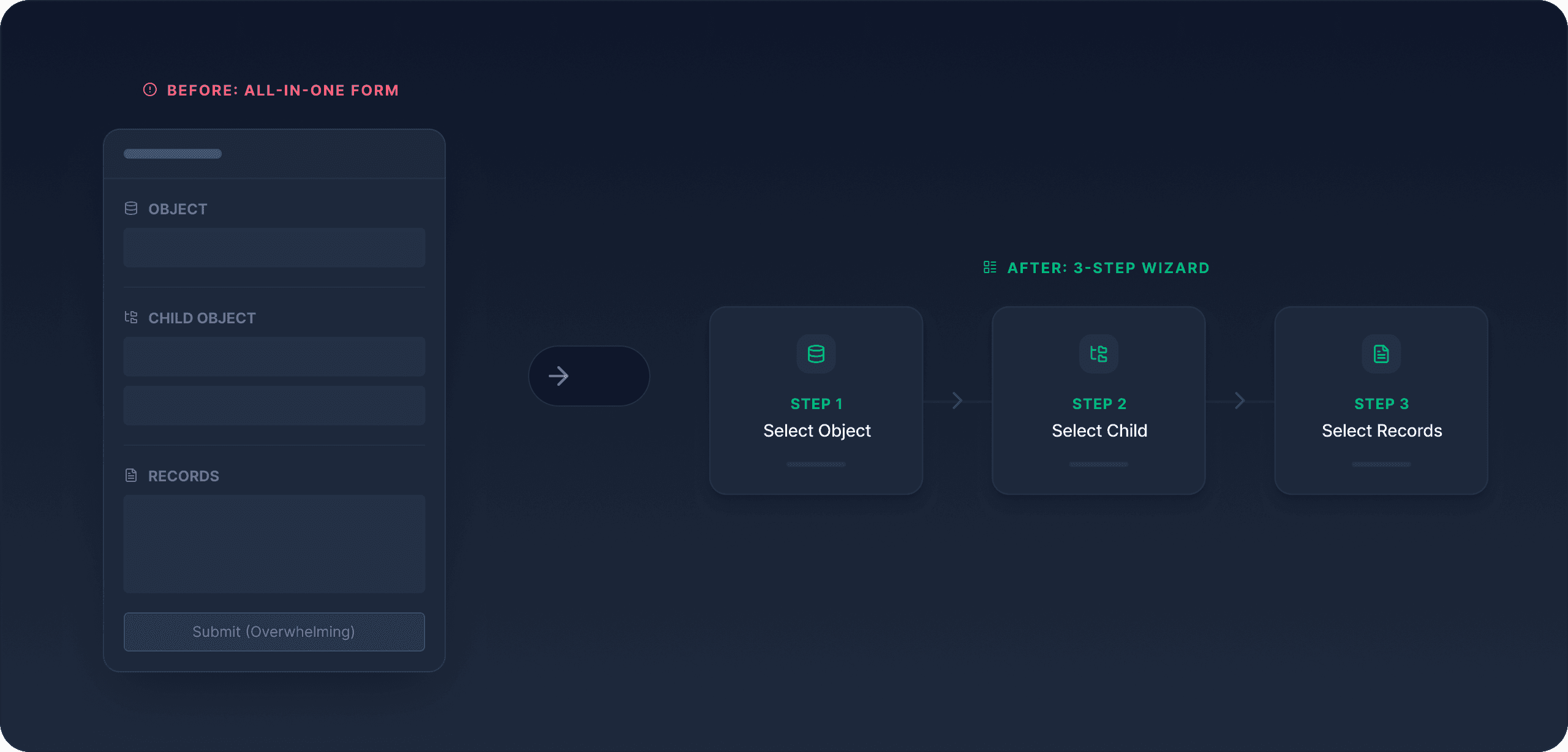
I staged complexity instead of removing it
I staged complexity instead of removing it
Right after those interviews, I redesigned the flow. Instead of exposing all controls on a single page, I staged decisions across the journey. Each step focused on one question, one choice, one mental commitment. We tested this version with the remaining users, and the feedback shifted immediately. They described the experience as clearer and easier—even though the underlying system complexity hadn’t changed. What changed was how that complexity was organized.
Right after those interviews, I redesigned the flow. Instead of exposing all controls on a single page, I staged decisions across the journey. Each step focused on one question, one choice, one mental commitment. We tested this version with the remaining users, and the feedback shifted immediately. They described the experience as clearer and easier—even though the underlying system complexity hadn’t changed. What changed was how that complexity was organized.
/
What This Changed for Me
/
What This Changed for Me
/
What This Changed for Me
Triangulating a path through ambiguity by testing assumptions early
Triangulating a path through ambiguity by testing assumptions early
This project reshaped how I think about ambiguity and complexity. I learned that waiting for perfect information is often the riskiest move. Momentum creates learning. Early designs aren’t about being right, they’re about exposing fragile assumptions as quickly as possible. I also learned that complexity doesn’t need to be eliminated to be usable. It needs to be shaped around how people think, decide, and focus. Since then, I’ve approached uncertain problems by moving early, testing the most dangerous assumptions first, and structuring complexity into forms humans can actually process.
This project reshaped how I think about ambiguity and complexity. I learned that waiting for perfect information is often the riskiest move. Momentum creates learning. Early designs aren’t about being right, they’re about exposing fragile assumptions as quickly as possible. I also learned that complexity doesn’t need to be eliminated to be usable. It needs to be shaped around how people think, decide, and focus. Since then, I’ve approached uncertain problems by moving early, testing the most dangerous assumptions first, and structuring complexity into forms humans can actually process.